

In a recent peer review article I read entitled “Art Integration and Cognitive Development” (Baker, 2013), the author researched the role of arts integration in an elementary school curriculum in a school devoted to arts integration. She also wanted to see if arts integration related to cognitive development in children and she wanted to see if her study could contribute to informing instructional practice as it relates to arts integration. The school in her study focused on arts integration through thematic units.
Her conclusion was that “even instruction based in a standard course of study, can be guided by thematic objectives interwoven with the arts to yield rich and complex forms of learning for children that promote conceptual and intellectual development through their inter-relatedness to overall instructional concepts and objectives.” p. 13-14. (Baker, 2013).
 I strongly believe that arts integration can be beneficial to student learning, as it can connect disciplines and concepts in learner’s experiences. Often connections are not distinctly made in a classroom due to the manner in which subjects are taught separately in most American Schools. Interdisciplinary thinking across subjects was mentioned in her article and the idea that dividing learning into fragments across a students day hinders connections in learning. (Baker, 2013).
That brings me to Technology Integration….

I have to be honest here… sometimes the technology I use in classrooms distracts from the hands-on work on constructing and glazing ceramics. I call that…

I have found that appropriate use of technology can speed along projects but it can stall them out too. A good example was a recent research project I had my students do on Google Sheets. It looked great but they could not add images without coding the images each time they dropped them in. Frustrating. And my school district has STARTED BLOCKING STUDENT ACCESS TO MY GOOGLE DOCS, FORM, SHEETS…. This is enjoyable to no degree.
But when I use technology for researching and demonstrating methods I find the biggest successes with technology in relation to student learning. I think this interweaves with arts integration and technology and arts integration can be more engaging and enrich the classroom environment when used effectively.
And authenticity – that is really hard to get perfect in a classroom.
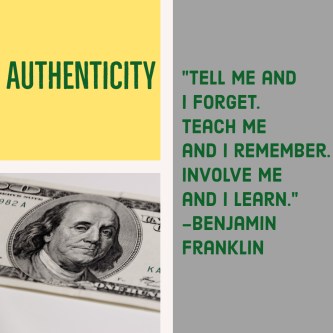
I read this article and it was a good reminder of what an authentic learning environment should be. The use of technology in the classroom contributes to authenticity in many ways, as our world is so saturated with technology.
The best quote from the article was, “From the standpoint of the child, the great waste
in school comes from his inability to utilize the experience he gets outside while on the other hand he is unable to apply in daily life what he is learning in school. That is the isolation of the school–its isolation from life.” (Dewey, 1915).
Resources
Baker, D., (2013). Art Integration and Cognitive Development. Journal for Learning Through the Arts: A research journal on arts integration in schools and communities. Retrieved from: https://files.eric.ed.gov/fulltext/EJ1018320.pdf
e-Teaching: Management Strategies for the Classroom, (April, 2016). Authentic learning: what, why and how? Retrieved from:
http://www.acel.org.au/acel/ACEL_docs/Publications/e-Teaching/2016/e-Teaching_2016_10.pdf
 Amy's EdTech 541 Blog Spring 2019
Hello Amy! I really enjoyed reading your post and appreciated all the visual elements you embedded throughout. This made your post very engaging and visually pleasing, it made me smile! I agree that learning environments need to be authentic and take what students know and have already learned outside of school to apply within the classroom. I’m surprised to learn that your school district is blocking the Google Apps for Education and hope that is something that can get figured out eventually. I’m sure that has caused many hiccups in your instruction. I think that a way to create more authentic learning environments is to have students solve problems that are relevant to them and their lives. When you are able to incorporate something that they care about and empower them with technology tools, that can help bridge the gap between school-life and life. Great post!
LikeLike
Thank you for your comment. I was pretty annoyed that all the Google Forms I have prepared for instruction are blocked now. I had to go in and redo my latest survey about student lesson needs into a district supported Microsoft Form. IT wants to monitor every message and transaction for all teachers and students so they are beginning to move all apps we use into Microsoft Teams for use only there. It is a nightmare. It is starting to happen to my YouTube channel too – kids can’t see my video instructional content. Someone in my district is probably getting a huge kickback from Microsoft somewhere. Google Apps are real life and authentic tools. Once students leave the bubble of Microsoft 365 for free with our district they lose all their resources, images, products, etc. Makes my job double the work to redo everything and absolutely no communication about these changes from the district makes it a huge surprise for a lot of us who rely on Google Apps in our Classrooms.
LikeLike