
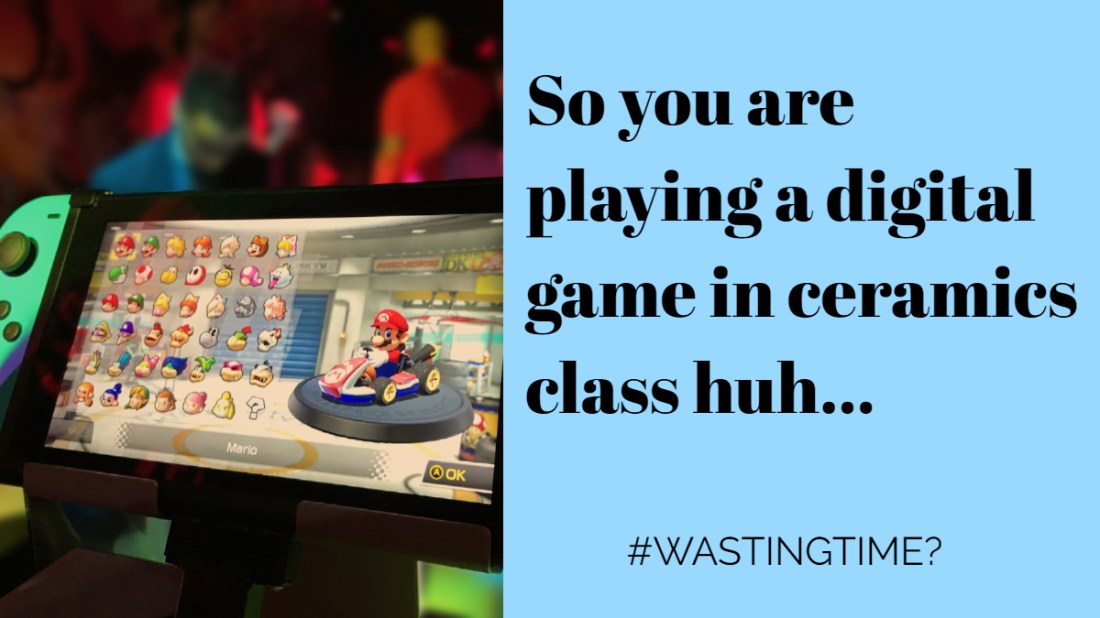
 Games…the excitement, the rewards in the brain for leveling up and getting prizes, the colors, sounds, the escape from the real world…It’s all there in a digital game for many people. In my classrooms I see kids sneak onto online games to avoid doing their work and then when they are behind in their work and have a D or F their parents wonder why the teacher is so bad at teaching their precious child.
Here are some questions I have been asked about game-based learning in my many years as a ceramics teacher:
- Why don’t you have students do all their drawing and planning in games?
- Why don’t you make it all digital so they are more engaged digitally?
- Why don’t you invite Google experts in the classroom to talk about all the amazing tech stuff out there that kids can use to learn with?
- You could buy some gaming devices for your classrooms like VR or AI stuff.
- Make it this, add that, include excitement…
- Why don’t you use that cool pottery app where they digitally create ceramics work on an app.
So I have answers and they usually sound like excuses. Basically, this graphic sums up how I use gaming in the ceramics room:

And yes, that would be a large void.
Why?
BECAUSE IT IS CERAMICS. WE WORK WITH CLAY. THE EARTH – THE REASON YOU ARE HERE ON THIS PLANET. IT IS ONE OF THE OLDEST ART FORMS THAT IS STILL ALIVE. KIDS LOVE IT AND THEY ARE ENGAGED WITHOUT A DIGITAL DEVICE OR GAMES. DIGITAL GAMES GET IN THE WAY OF THEM WORKING WITH CLAY IN THEIR HANDS.
(And when your child’s expansive i-phone falls in a bucket of wheel throwing water you will ask me to stop allowing students to have digital devices in the ceramics room.)
Of course, I have another visual for you… Here is a better explanation:

Use of digital tools and gaming in the ceramics room
Ok- I do use apps for drawing and designing in the classroom and it does not have to be a game that provides a digital reward for students to gain confidence in their work and practice with skills. Students create websites to house their artwork to show others and share their learning. Google doesn’t have time for our students. Period. My budget is five dollars per kid. Tech gear is expensive and schools and students who are marginalized by society don’t get free gear.
Does game-based learning fit in a ceramics room?
 Yes, game-based learning can fit into the design aspect of ceramics learning. In my website for the EdTech 541 course, I am currently working on integrating games-based learning into a lesson for designs with decals or glazes for my students. You can check it out here and it should be completed in a day or two. Any suggestions from my few readers are greatly appreciated in the comments section below. For ideas about game-based learning I watched some very interesting videos about creativity and while watching these I got the idea that I could use games with students to develop ideas for designs. Since I teach PBL mostly, I have structured the lesson as a PBL lesson with groups working together in groups of 4 to explore 4 different games. Each group will decide how they want to explore the four games and share their finding with each other and the larger class. Then students will help each other to develop designs for the ceramics project they are currently working on. This part leaves the flexibility open so the lesson can fit any ceramics project. It could be a group project or an individual one.
I do see a use for and an advantage for using game-based learning in the classroom, but in the ceramics room it is so specialized and the content is based on making things with clay. The design approach in ceramics, however, does lend itself to game-based learning in some ways. Most drawing and design games are not very well developed yet and in the future, I see this opportunity as huge for developers. Google Experiments already has a global following and developers and innovators are on the cusp of great things.
The entry event for this lesson is a video about Google Tilt. It is very engaging and shows the future of digital gaming and drawing and soon to be collaborative creating in gaming environments. Google Tilt
The games used in the lesson are:
Game 1: Recursive Drawing Game
Game 2: Art Palette
Game 3: Aminahs World
Game 4: Autodraw
Game 5: Pottery HD Lite
Resources:
Behar, Y. (2008). Designing objects that tell stories. Retrieved from:
https://youtu.be/MRao9R7LRB4
Brown, T. (2008). Tales of creativity and play. Retrieved from: https://www.ted.com/talks/tim_brown_on_creativity_and_play
Farber, M. (2016). 3 Ways to Use Game-Based Learning. Edutopia. Retrieved from: https://www.edutopia.org/article/3-ways-use-game-based-learning-matthew-farber.
 Amy's EdTech 541 Blog Spring 2019
I LOVE all of your graphics and everything that supported what you were saying. Great post
LikeLike
Amy I really enjoyed your post. As I was reading the thing that kept coming back to me is this page is fun and full of personality. I thought your resources were wisely incorporated and appreciated how you are going to possibly implement game-based learning into your teaching. I also appreciated your honesty in your post.
Thanks
LikeLike
Thank you. I try to honest and real. In a staff meeting today I did say I have nothing to lose by telling the truth…and sometimes the truth is painfully funny…
LikeLike
Hi Amy,
I like how you are creating a game for decals and glazes for ceramics. Very cool! While I don’t know too much about ceramics, I feel like there is a level of science that goes into glazes, oven temperatures, changes that the clay undergoes during the process. Maybe there is digital content out there that would allow students to see what happens to ceramics at an atomic level when heated? I definitely agree that a subject like ceramics is supposed to be as hands-on as possible. Have you thought of possibly using these types of online games and simulations as homework assignments to prepare students for a new lesson or to understand the next step in their ceramics process?
LikeLike
That’s a really great suggestion to look at the science of the kiln firing. I think if I found a good game site for exploring the chemistry of glazing and the reactions that occur during the firing process it would be interesting. There really isn’t anything out there game wise that I could find that was worthwhile though. I talk about how glazes are formed and refer to Ancient Egyptian carvings made from mysterious gems, but actually glass. Some call it from “Tutankhamun’s fireball”. Basically, a giant meteor explosion above the earth’s surface happened in the desert outside Cairo and created a giant sheet of glass from the heated sand. Over time the glass broke into bits and people used it. If someone made a game that was like a choose your own adventure or solve the mystery and it had concepts that explored heat and melting points and oxygen rich environments vs. reduction environments I would use it…Looks like I picked the wrong career…maybe game design and coding was my real calling…maybe not… – Amy
LikeLike
Hi- Thank you for your comment, I just saw this comment – somehow I have not been able to see comments until recently. Yes, there is a science to glazing and firing. I cover it in my coursework but have yet to write up a lesson for this course. There is not much out there on the internet for games that are relevant or rigorous enough for my ceramics courses. Most is superficial and I would get “scolded” by my admin for using any of the games out there. I also don’t do homework…crazy thought right?
LikeLike